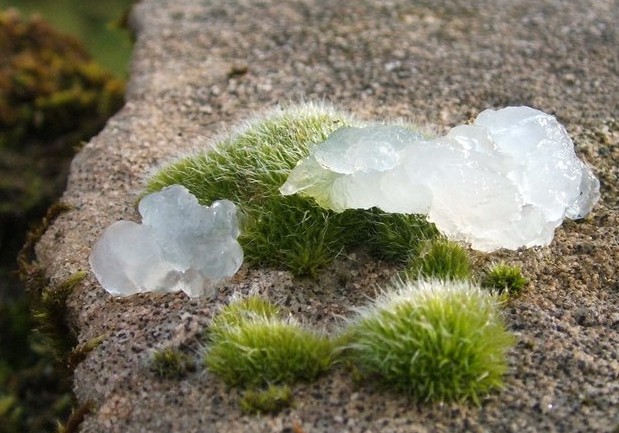
Every so often, walkers, gardeners, and wildlife enthusiasts stumble across something strange: a translucent, jelly-like blob shimmering on grass, soil, or even tree branches. It looks otherworldly — as if something has fallen from the sky.
For centuries, people believed exactly that.
This mysterious substance is commonly known as star jelly, or more whimsically, “star snot.”
Folklore across Europe describes star jelly as a residue left behind by shooting stars, meteor showers, or celestial events. Medieval chronicles recorded sightings of gelatinous masses appearing suddenly after meteor sightings, reinforcing the belief that it had cosmic origins.
Even today, the name carries that sense of wonder.
But science tells a different story.
Despite its poetic name, star jelly is not extraterrestrial. Researchers and naturalists have proposed several likely explanations:
One of the leading theories links star jelly to frogs and toads.
Predators such as herons, foxes, or crows often eat amphibians but discard parts of their reproductive organs. When these tissues absorb moisture, they swell dramatically into clear, gelatinous blobs — creating the eerie “jelly” people later discover.
Some sightings may be colonies of cyanobacteria (sometimes called blue-green algae), such as Nostoc. These organisms live invisibly in soil but expand into jelly-like masses after rain.
Occasionally, certain slime moulds can resemble star jelly, though they are typically more structured or coloured.
Star jelly often seems to “materialise overnight,” which adds to its mystique. In reality:
- Rain or dew hydrates previously unseen material
- Transparent tissues are easily missed when dry
- Nocturnal predator activity goes unnoticed
The result? A morning surprise.
The good news is that star jelly is generally harmless. It poses no threat to people, pets, or plants. However, it does offer a fascinating glimpse into the hidden dramas of the natural world:
- Predator-prey interactions
- Soil microorganisms responding to moisture
- The strange transformations of organic matter
Nature rarely wastes anything — but it certainly surprises us.
For the Ongar Wildlife Society, star jelly is a wonderful example of how easily the natural world can spark imagination. What once inspired myths of falling stars now tells stories of ecology, behaviour, and biology.
So next time you spot a glistening blob in the grass…
✨ It may not be from the cosmos —
…but it’s still a little bit magical.